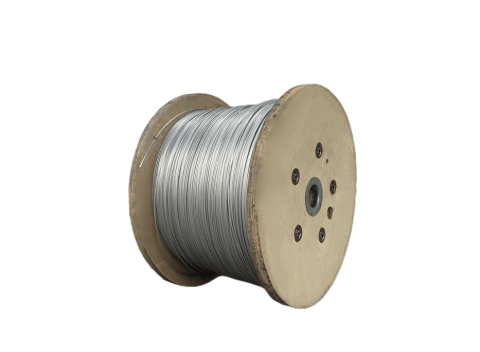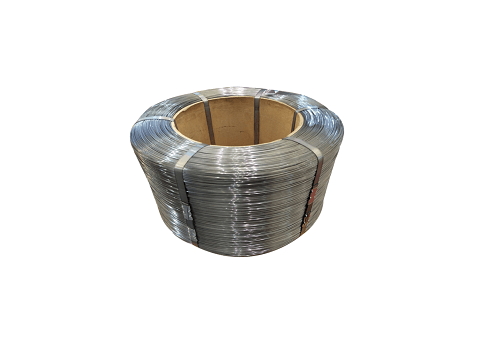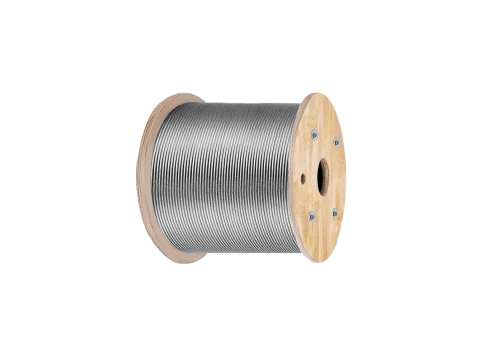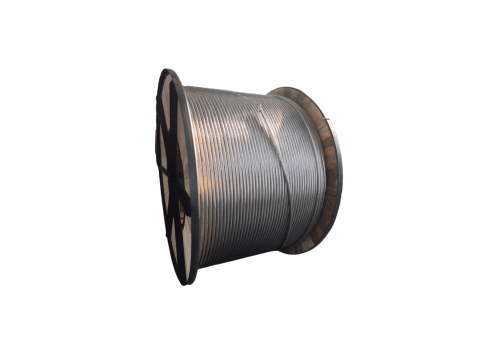
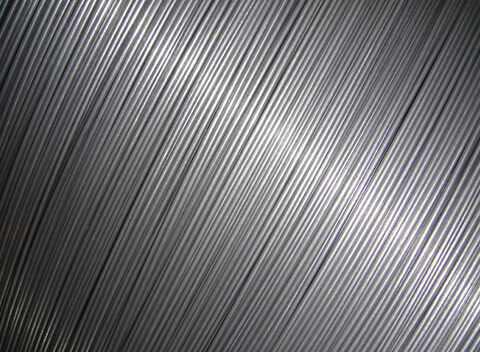
-Invar steel is an iron–nickel alloy characterized by an extremely low coefficient of thermal expansion, showing almost no length change with temperature variation.
-Aluminum-clad Invar steel exhibits a thermal expansion coefficient of 3.7 × 10⁻⁶ /˚C below 230˚C, which is approximately one-third that of standard carbon steel and one-sixth that of aluminum.
-The aluminum cladding provides enhanced high-temperature resistance and excellent corrosion protection.
LBY10
LBY14
| Level | Grade | Diameter | Min. Tensile Strength | Min. Sress at 1% Elogation | Min.Elogation at Fraction | Min. Elogation after Fraction | Max. Resistance at 20℃ |
| (mm) | (MPa) | (MPa) | (%) | (%) | (nΩ·m) | ||
| LBY10 | - | 1.50<d≤2.66 | 1180 | 1100 | 1.5 | 1.0 | 172.41(10%IACS) |
| 2.66<d≤3.00 | 1150 | 1070 | |||||
| 3.00<d≤3.50 | 1130 | 1050 | |||||
| 3.50<d≤4.25 | 1070 | 1000 | |||||
| 4.25<d≤4.80 | 1010 | 940 |
| Level | Grade | Diameter | Min. Tensile Strength | Min. Sress at 1% Elogation | Min.Elogation at Fraction | Min. Elogation after Fraction | Max. Resistance at 20℃ |
| (mm) | (MPa) | (MPa) | (%) | (%) | (nΩ·m) | ||
| LBY14 | - | 1.85<d≤5.00 | 1080 | 1030 | 1.5 | 1.0 | 123.15(14%IACS) |
-Extremely low thermal expansion: Invar (Fe–36%Ni alloy) has a coefficient of just 3.7×10⁻⁶ /°C below 230°C—significantly lower than that of steel or aluminum—ensuring exceptional dimensional stability under temperature changes.
-Excellent dimensional stability: Nearly no deformation with heating or cooling, ideal for applications sensitive to conductor length changes, significantly reducing tension variations caused by thermal expansion.
-Superior corrosion resistance: Aluminum cladding enhances overall corrosion resistance, suitable for humid, salty, and harsh environments, extending service life.
-Good high-temperature performance: Stable operation in high-temperature environments without degradation.
-Good electrical conductivity and compatibility: ensures good electrical conductivity and excellent electrochemical compatibility with aluminum conductors and fittings, preventing galvanic corrosion.
-Special overhead conductor cores: Suitable for cables with extremely high requirements for thermal stability and expansion resistance, such as those in areas with large temperature variations, high latitudes, and high-voltage lines.